
Xena Safety Guide
Engineered for women.
Not shrunk down from men’s.
What “women’s safety footwear” actually means — and how to find protection that actually fits.
Shop women’s safety shoesThe history
Why “women’s” boots have never really fit women
For decades, the work boot industry solved women’s sizing the easy way: take a men’s last — the foot-shaped mold every boot is built around — scale it down, and call it a women’s boot. The assumption baked into that process was that women’s feet are just smaller men’s feet. They’re not.
Women’s feet differ from men’s in more than length. Our feet are wider around the ball of the foot and more narrow in the heel. Also (on average) we tend to have higher arches, a lower ankle bone and a shallower instep.
Shrinking a men’s last doesn’t correct for any of that — it just makes a smaller version of the wrong shape. That mismatch is exactly why so many “women’s” safety boots slip at the heel, crowd the toes, and leave you exhausted by the end of a shift.
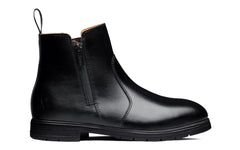
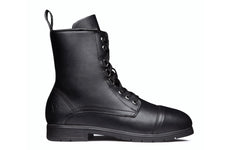
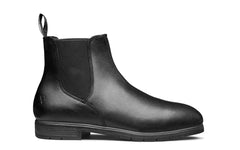
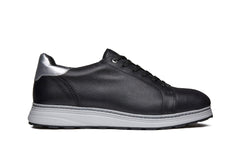
Xena starts from a different point. Every style is built on a last designed around a woman’s foot from day one — then certified to the same ASTM F2413 standard as any other safety boot on the market.

A smaller men’s mold in a “women’s” box was never a women’s boot. Real protection starts with the right shape — then earns the certification.
The standard
What makes a shoe a “safety” shoe?
A real safety shoe starts with a protective toe cap — steel, composite, or other materials — tested to ASTM F2413 for impact (I/75) and compression (C/75). From there, most styles add more protection depending on the hazard:


Add puncture resistance (PR) to the list, too. The rule holds either way: no certified toe, no safety shoe — just a work shoe.

Why it matters
What the wrong fit actually costs you
Get the fit wrong and it shows up fast — heel slip that turns into blisters, a toe box that has you fidgeting by mid-morning, arches with nothing left to give by hour eight. On a job site, that’s not a minor annoyance. It’s what pushes people into taping their heels, doubling up on socks, or just toughing it out in boots that were never built for them.
Start with a true women’s last and none of that is necessary. The fit is right from the first wear — no workarounds required.
Built + certified
How Xena is built and certified
Every Xena style is ASTM F2413 certified (I/75 C/75) and engineered on a women’s last. Xena is a certified women-owned business (WBENC & WOSB), founded in 2019 by an ASTM Committee Board Member. Browse the full range of women’s safety shoes, or shop by steel toe, composite toe, or soft toe.
Pick your pair
How to choose the right pair
Start with whatever your employer requires — toe type and ratings like EH or SD. Pick the style that fits your work and your personality. Then run the Fit Finder on any product page for a size you can trust. Want the standards in plain English first? Read ASTM F2413 & OSHA, explained.